CLINTON'S APOLOGY
"Our government is supposed to protect the rights of its citizens; their rights were trampled upon."
- President Clinton addressing the survivors of the study (1997)
FORMAL APOLOGY
|
In 1997, twenty-four years after the Tuskegee Study's termination, President Clinton issued the first formal apology to its victims.
"[T]he presidential apology was a way of the Federal government taking responsibility... it's meaningful in that it tells us that society has changed to the degree that something like the Tuskegee study that was once acceptable, at least acceptable enough to enough people that it actually happened, is no longer acceptable." - Carol Kaesuk Yoon, investigative reporter,
in a student e-mail interview |
Excerpt from President Clinton's apology to Tuskegee study participants, provided by the Clinton Library
|
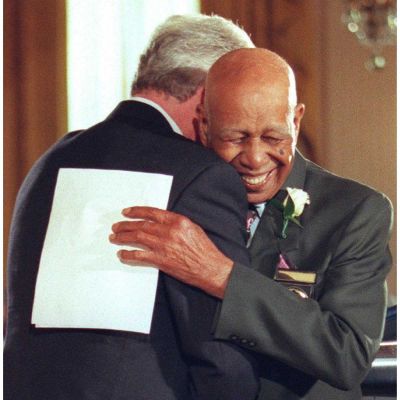
"Ninety-four-year-old Herman Shaw embraces President Bill Clinton after receiving a public apology for being victimized in the Tuskegee Syphilis Study" (AFP Photo 1998)
|
Excerpt from President Clinton's apology to patients of the Tuskegee Study
"It was a time when our nation failed to live up to its ideals, when our nation broke the trust…that is the very foundation of our democracy." - President Clinton addressing the
survivors of the study (1997) |
"An apology is the first step, and we take it with a commitment to rebuild that broken trust. We can begin by making sure there is never again another episode like this one. We need to do more to ensure medical research practices are sound and ethical, and that researchers work more closely with communities..." - President Clinton addressing the
survivors of the study (1997) |
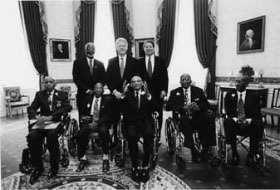
"White House apology ceremony, 16 May 1997. Participants and survivors of the study"
(White House Photography Office 1997)
|
Apology Transcript
BIOETHICS COMMISSIONS
|
Tuskegee was a seminal event and, arguably, the one that gave modern bioethics its beginning in the USA.
- Dr. Stuart Younger, Chairman of the Department of Bioethics at Case Western Reserve University, in a student e-mail interview
In his speech, Clinton also announced the "exten[sion of] the charter of the National Bioethics Advisory Commission to October of 1999."
"As a first priority, the Commission will direct its attention to consideration of protection of the rights and welfare of human research subjects..." - President Clinton speaking to the survivors of the study (1997)
|
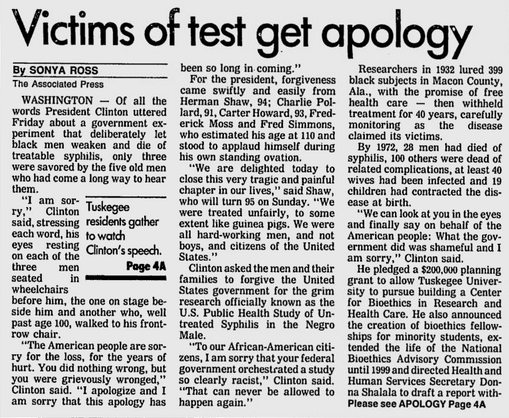
This newspaper article mentions the extension of the "life of the National Bioethics Advisory Commission until 1999" (Tuscaloosa News 1997).
|
"PRESIDENTIAL COMMISSION FOR THE STUDY OF BIOETHICS ISSUES"
"The President’s Commission is one of a series of commissions that we’ve had in the United States to think about, deliberate in public issues about bioethics and to make recommendations to various bodies in the United States. "
- Dr. Christine Grady, Chief of the Department of Bioethics at the National Institutes of Health Clinical Center
and member of the Presidential Commission for the Study of Bioethical Issues, in a student phone interview
and member of the Presidential Commission for the Study of Bioethical Issues, in a student phone interview
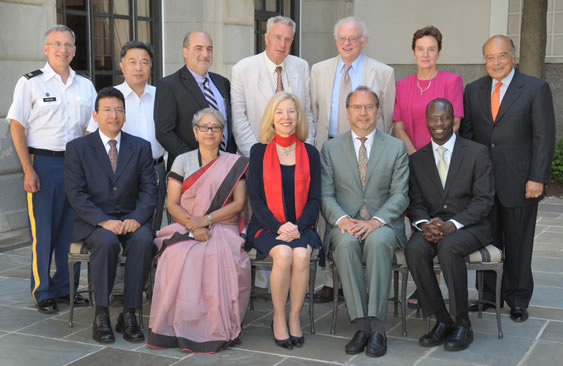
"The Presidential Commission for the Study of Bioethical Issues was created by President Obama in November 2009. It advises the President on bioethical issues that may emerge from advances in biomedicine and related areas of science and technology." (miami.edu)
|
"As our nation invests in science and innovation and pursues advances in biomedical research and health care, it's imperative that we do so in a responsible manner." - Barack Obama, current president of the United States (2009)
"The National Commission for the Protection of Human Subjects of Biomedical and Behavioral Research (1974-78)" is generally viewed as the first national bioethics commission." This commission "[e]stablished as part of the 1974 National Research Act", set a precedent for future commissions to protect the rights of human subjects in research. ("History of Bioethics Commissions" n.d)
|